

Canva’s 22% Workforce Cut: The Hardest Leadership Test Comes After the Redundancies
Melanie Perkins has shown how to deliver difficult news with humanity. But as I learned at Cisco Systems, the real test of leadership begins when the people who remain return to work.
There are moments in the life of a company when everything changes. Not because a competitor launches a better product or because the market takes a sudden turn, but because the business is forced to confront a reality that nobody really wanted to contemplate.
For Canva, that moment has arrived.
The announcement that 22 percent of its workforce is being cut, changed or relocated, affecting 1,271 roles, is an extraordinary development for one of Australia’s greatest technology success stories.
And I suspect it has been an incredibly difficult period for Melanie Perkins, Cliff Obrecht and Cameron Adams, who have spent years building not just a valuable business, but a distinctive workplace culture.
Canva was the Australian technology darling. The company everyone admired. The business that seemed to have cracked the code on attracting exceptional talent, building a genuinely different culture and competing on the global stage.
Now it faces a very different challenge.
And I’ve seen something remarkably similar before.
I remember when Cisco Systems faced its own moment of reckoning
Nearly 25 years ago, I was working at Cisco Systems during one of the most extraordinary periods in the technology industry’s history.
Cisco was a powerhouse.
We were recruiting exceptional people, building incredible technology and operating in an environment where growth seemed almost unstoppable.
The company had a reputation for hiring the best of the best. There was enormous pride in being part of the business.
But Cisco also had a longstanding commitment to avoiding mass layoffs. When workforce changes were necessary, the preference had been to manage them through other means.
Then the technology market collapsed.
Suddenly, even Cisco wasn’t immune.
In 2001, the company announced workforce reductions affecting approximately 8,500 employees and contractors. For a business that had spent years building an extraordinary culture around its people, it was a devastating turning point.
I remember receiving the communication from our CEO, John Chambers.
He was clearly struggling with the decision. He was empathetic, direct, and deeply conscious of the consequences for employees and their families.
But what stayed with me wasn’t simply his regret.
It was his determination to make the necessary changes decisively, rather than subject employees to a seemingly endless series of redundancies.
His philosophy was that when difficult decisions had to be made, they needed to be made properly.
Not a little cut this month, another cut next quarter, and another restructuring six months later.
Because that is how you destroy confidence inside a business.
And that lesson has stayed with me throughout my executive career.
The remarkable parallel between Cisco and Canva
What makes the comparison particularly interesting is that both businesses faced fundamental changes in their respective technology markets.
Cisco was caught in the collapse of the dot-com boom and a dramatic slowdown in telecommunications investment.
Canva is facing a different disruption.
Artificial intelligence is fundamentally changing the economics of software, product development, design, and technology businesses.
The very skills companies were aggressively recruiting just a few years ago are being reassessed.
Teams are being consolidated. Specialist positions are being redesigned. Management structures are being challenged.
And the uncomfortable reality is that some businesses are discovering they may no longer need the same number of people, or the same mix of capabilities, to deliver their products and services.
This doesn’t mean the employees being released are poor performers.
Quite the opposite.
Many are exceptional professionals, recruited precisely because they were among the best in their fields.
Their positions may no longer fit the organisation’s future operating model. That is a very different proposition from suggesting they have somehow failed.
For many of these people, the psychological impact will be enormous.
When you’ve joined a celebrated technology business, embraced its culture and invested years of your professional life in its success, redundancy can feel like a profound rejection.
Even when you intellectually understand the commercial rationale.
What Melanie Perkins got right
I’ve read David Swan’s reporting in The Sydney Morning Herald about Canva’s restructuring, and several things stand out.
First, Melanie Perkins fronted the announcement herself.
She didn’t disappear behind the HR department or leave middle management to carry the entire emotional burden.
She took ownership.
Her communication acknowledged the human consequences of the decision and expressed genuine regret.
The company also appears to have given considerable thought to how departing employees would be treated.
The reported arrangements include a minimum of six months’ salary, opportunities to explore other internal positions, continued access to workplace systems for a short period to say goodbye, and grants of US$10,000 for eligible departing employees who want to start businesses.
These are meaningful measures.
And they stand in stark contrast to some of the restructuring processes I’ve seen across corporate Australia.
I’ve encountered executives who have spent decades building businesses, only to find themselves suddenly redundant, with minimal support and very little understanding of what comes next.
Sometimes there is no meaningful career transition assistance at all.
A payout is provided, access is removed, and the employee is effectively left to navigate an extremely difficult executive employment market alone.
That is not good enough.
Canva deserves recognition for taking a more considered approach.
But generosity alone doesn’t make a redundancy process successful.
You can deliver the most compassionate redundancy announcement in the world and still lose the trust of the people who remain.
And that is where the real leadership challenge begins.
The employees who stay are watching everything
In my experience, the greatest cultural damage from mass redundancies often becomes visible months after the announcements.
The immediate shock eventually passes.
The farewell messages stop appearing on LinkedIn.
The departing employees move on, or at least begin trying to.
And the people who remain return to their desks.
Except everything feels different.
Colleagues have disappeared. Teams have been dismantled. Reporting lines have changed. Workloads have shifted.
People start asking questions they may never have considered before.
- Am I safe?
- Will there be another round?
- Is the business really in trouble?
- Should I start looking elsewhere before my position disappears?
- And perhaps most importantly, can I still trust what leadership is telling me?
This is where companies can get themselves into serious trouble.
I’ve watched organisations announce restructures with great confidence, only to return a few months later with another round of redundancies.
Then another.
And another.
Each time, the explanation sounds familiar.
The market has changed. We need to become more efficient. We’re realigning the business. We’re positioning ourselves for the future.
Eventually, employees stop believing the messaging.
They become guarded.
They stop taking risks.
They become reluctant to challenge decisions or speak openly about problems.
A workplace that once thrived on innovation can become a workplace focused on self-preservation.
Fear is a terrible operating model for a business that depends on creativity and innovation.
The danger of creating a workplace where everyone is fighting to survive
There is another consequence of repeated restructures that I don’t think gets enough attention.
The people who leave don’t simply disappear.
They remain connected to their former colleagues.
They continue to communicate through LinkedIn, professional networks, and friendships.
And when talented former colleagues are still unemployed six or twelve months later, the people inside the organisation notice.
They see exceptional executives struggling to secure interviews.
They see people accepting positions well below their previous seniority.
They see former colleagues dealing with financial pressure, professional uncertainty and the emotional toll of prolonged unemployment.
And they start imagining themselves in exactly the same position.
I’ve seen this create an almost Fight Club mentality inside organisations.
People become more concerned about protecting their own positions than working together to build something better.
Internal politics intensify. Collaboration suffers. Trust deteriorates.
The irony is that businesses undertaking restructures to improve productivity can end up creating a culture that undermines the very performance improvements they are trying to achieve.
That is why the period after a major restructure is so important.
Leadership has to do far more than explain the financial rationale.
It has to give people a reason to believe in the future again.
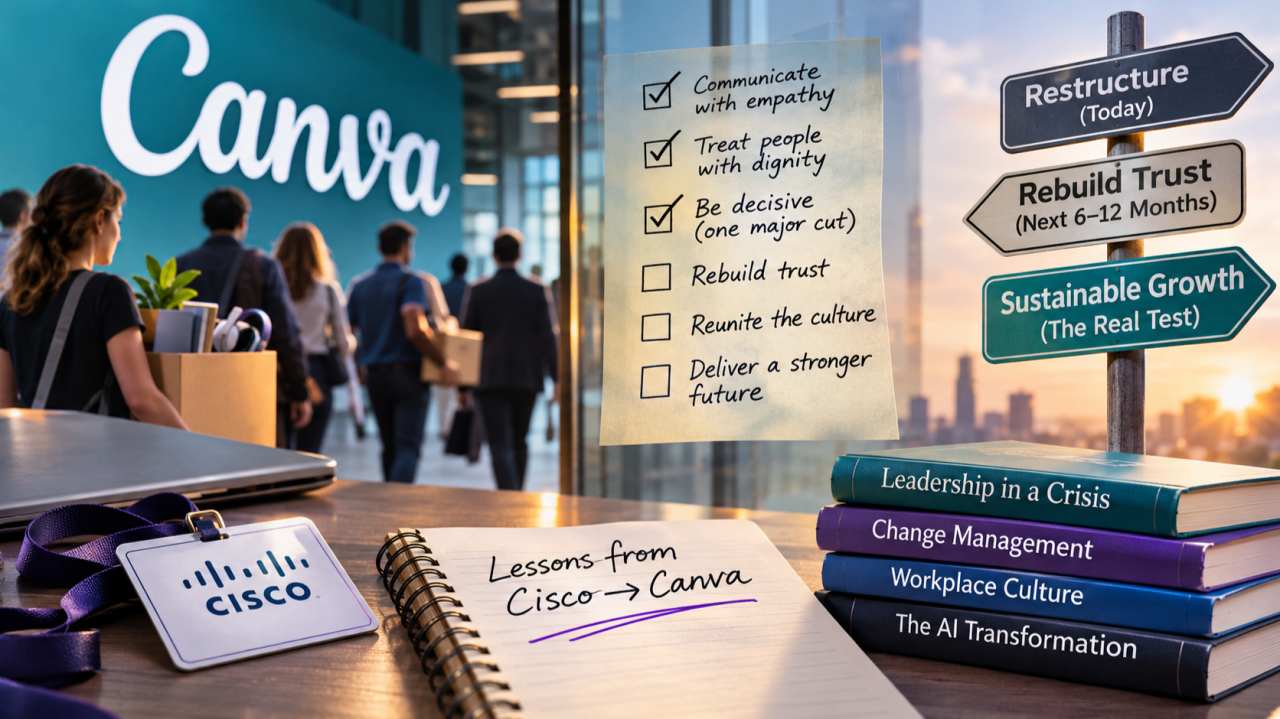
One decisive restructure is better than death by a thousand cuts
One of the most important lessons I took from John Chambers was the importance of avoiding a prolonged cycle of uncertainty.
He understood that repeated redundancies could be deeply damaging to a workforce.
And while no CEO can guarantee that further changes will never be necessary, there is enormous value in confronting the scale of a problem rather than making a series of smaller decisions that prolong the pain.
This is where Canva may have made the right call.
A reduction affecting 22 percent of the workforce is substantial.
But if it allows the company to genuinely reset its operating model, strengthen its financial position and establish a sustainable foundation for future growth, there may be a strong commercial rationale for acting decisively.
The critical word is if.
Because there is no guarantee that one major restructure will be enough.
AI is moving at an extraordinary pace.
Competitive threats are changing. Product development cycles are accelerating. Customer expectations are shifting.
Canva’s leadership may find that the assumptions underpinning today’s restructuring need to be revisited sooner than expected.
And that is the risk.
Another significant round of redundancies could be far more damaging to employee confidence than the first.
The workforce will be watching closely.
So will investors, customers and the broader technology community.
Rebuilding the culture will be harder than announcing the cuts
Canva’s founders have spent years building a culture around creativity, collaboration and being good humans.
Those values are now being tested in circumstances that are far more difficult than the years of extraordinary growth.
The challenge is no longer simply attracting talented people into the business.
It’s convincing the talented people who remain that they still have a future worth investing in.
That requires genuine transparency about the company’s commercial position.
It requires explaining how the new operating model will work, what success looks like and what employees are expected to deliver.
It means bringing people into the conversation rather than simply presenting another beautifully crafted corporate message.
And it means giving managers the confidence and capability to lead teams through uncertainty.
Employees need to understand why the changes were necessary, what the company is trying to achieve, and how their individual contributions fit into that future.
They also need to see the leadership team making difficult decisions consistently, not asking employees to carry the entire burden while executives remain untouched.
Most importantly, they need evidence that the organisation is moving forward.
Not just words.
Evidence.
Better execution. Clearer priorities. More sustainable workloads. Products that customers genuinely value. A business that is becoming stronger rather than simply smaller.
That is how confidence starts to return.
The real verdict on Canva will come later
I have enormous respect for what Melanie Perkins and her co-founders have built.
Canva has demonstrated that an Australian technology company can compete with the world’s largest software businesses.
That achievement shouldn’t be diminished because the company is now confronting a difficult period.
But neither should we romanticise the redundancy process simply because the communication was compassionate and the financial packages were generous.
For the people losing their jobs, this is a deeply personal and potentially life-changing event.
For the people staying, it is the beginning of a period of uncertainty.
And for Canva’s leadership, it may be the most important test they have faced.
The true measure of this restructure won’t be the reaction to Melanie Perkins’ announcement.
It won’t be the headlines praising the redundancy packages.
And it won’t be the immediate financial savings.
It will be whether, six or twelve months from now, the people who remain still believe in the company, trust its leadership, and feel confident about its future.
I remember John Chambers and Cisco’s difficult turning point because it taught me something about leadership that has remained relevant throughout my career.
Great leadership isn’t only about inspiring people when everything is going well.
It’s about making extraordinarily difficult decisions when things aren’t going well, treating people with dignity and finding a way to bring the organisation together again.
Canva has taken the first step.
Whether it can rebuild the confidence, culture and momentum that made it so successful is the much bigger question.
And only time will tell.