

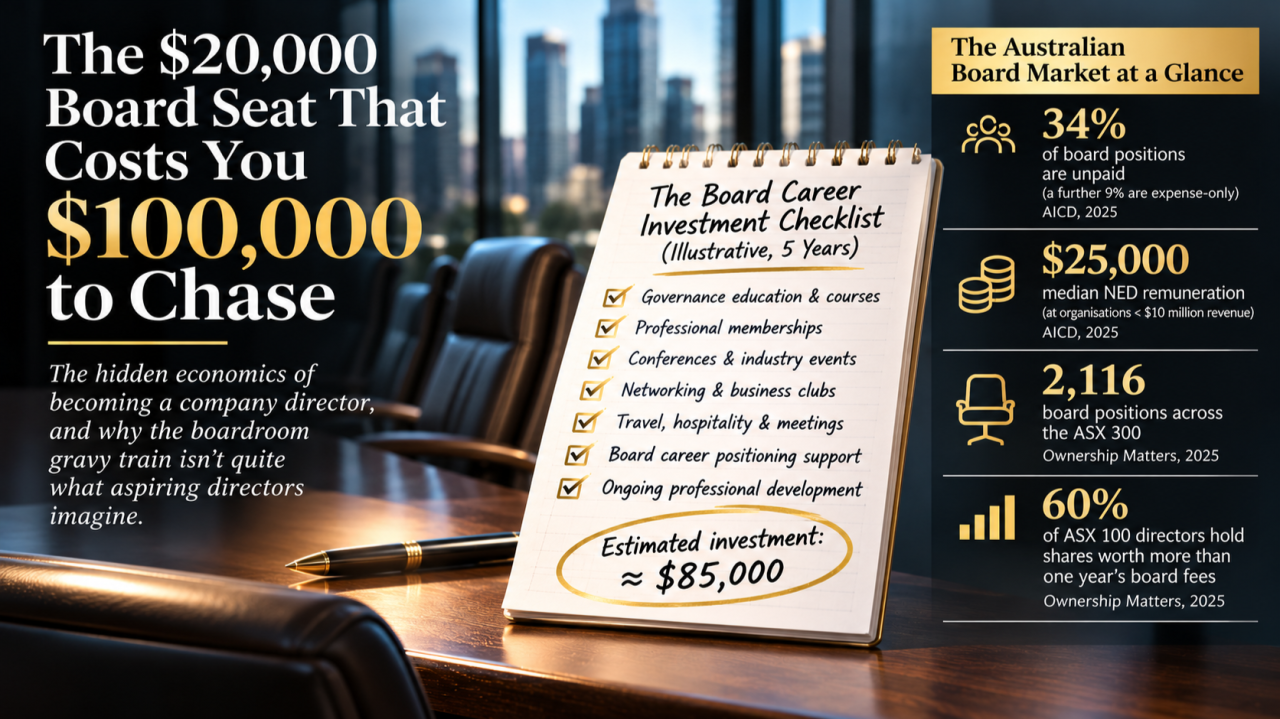
The $20,000 Board Seat That Costs You $100,000 to Chase
The hidden economics of becoming a company director, and why the boardroom gravy train isn’t quite what aspiring directors imagine.
There’s a rather romantic notion about becoming a company director.
You’ve spent 25 or 30 years building a successful executive career. You’ve managed large teams, delivered impressive commercial results and navigated your fair share of corporate challenges.
Now you’re thinking about the next chapter.
Perhaps three or four board appointments. A handful of meetings each month. Some interesting strategic conversations. A little interstate travel. And, ideally, $150,000 or $200,000 a year in director’s fees.
Not a bad retirement plan.
Except there’s one rather significant problem.
Most aspiring directors have absolutely no idea what it costs to get into the boardroom in the first place.
I’m not simply talking about completing a company director course.
I’m talking about years of professional development, governance education, networking, industry conferences, professional memberships, private clubs, interstate travel, and building relationships with the people who actually influence board appointments.
And that’s before you put a dollar value on your time.
You might spend $100,000 establishing your credentials and building your networks, only to secure your first paid board appointment at $20,000 a year.
If you secure one at all.
Welcome to the economics of becoming a company director.
My own investment? Not much change from $100,000.
I’ve spent more than two decades working in executive search, board recruitment, and governance advisory.
Over that time, I’ve invested a considerable amount of my own money in developing my professional credentials and building relationships across the business community.
I completed a Master of Laws in Enterprise Governance at Bond University, alongside other professional development programmes and courses to deepen my knowledge of corporate governance, director responsibilities and the increasingly complex environment in which boards operate.
My formal professional development alone has cost well over $50,000.
Then there’s everything else.
Professional association memberships. Business networking organisations. Private club memberships. Governance conferences. Industry events. Travel. Hospitality. And the countless hours spent developing relationships with senior executives, chairs, investors and company directors.
When I look back at the cumulative investment, I doubt there would be much change from $100,000. And that’s probably conservative. Would I do it again? Absolutely.
But I’ve never regarded professional development as an expense incurred simply to secure a board appointment. It’s an investment in my broader professional capability, commercial credibility and understanding of governance.
There’s an important distinction.
“A board career isn’t something you stumble into after a successful executive career. It’s something you deliberately invest in, often for years before you see a financial return.”
What the Australian board market actually pays
Let’s introduce some independent perspective.
The Australian Institute of Company Directors’ 2025 Director Remuneration Report, produced with Godfrey Remuneration Group, examined remuneration practices using responses from 1,352 directors across listed companies, private businesses, government organisations, not-for-profits and charities.
The findings paint a rather different picture from the glamorous image of a highly paid portfolio director.
For organisations generating less than $10 million in annual revenue, the median non-executive director remuneration package was just $25,000.
For chairs, it was $40,000.
At organisations generating between $10 million and $50 million, median non-executive director remuneration increased only slightly, to $27,000.
Contrast that with organisations generating more than $1 billion, where median non-executive director remuneration reached $105,000 and chair remuneration reached $180,000.
| Organisation revenue | Median NED | Median chair |
|---|---|---|
| Less than $10 million | $25,000 | $40,000 |
| $10 million to $50 million | $27,000 | – |
| More than $1 billion | $105,000 | $180,000 |
Source: AICD Director Remuneration Report 2025.
These are very different markets, with very different levels of responsibility, complexity and competition.
Not every board seat comes with a six-figure fee. Far from it.
The $20,000 or $25,000 appointment that an aspiring director might initially secure is entirely plausible.
These figures aren’t specific to first-time directors, but they offer a useful reality check for anyone imagining that every board appointment will deliver substantial income.
And many directors aren’t paid at all
The same AICD research found that 34 percent of surveyed board positions were unpaid, while a further nine per cent provided expense reimbursements only.
That’s 43 percent receiving no conventional director remuneration.
In the charity sector, 55 percent of positions were unpaid. Among not-for-profit organisations, the figure was 50 percent.
By contrast, 98 percent of surveyed listed-company positions were paid.
Source: AICD Director Remuneration Report 2025.
There’s absolutely nothing wrong with serving on an unpaid board. Some of the most rewarding directorships involve organisations where directors contribute because they believe in the purpose.
But unpaid doesn’t mean responsibility-free.
You’re still expected to understand the financial position of the organisation, oversee risk, exercise sound judgement and fulfil your legal obligations.
You may spend years developing your governance experience through unpaid appointments and still find yourself competing against hundreds of candidates when a paid opportunity finally emerges.
That’s a reality many aspiring directors don’t fully appreciate.
The qualification is only the beginning
One of the questions I’m regularly asked is whether aspiring directors really need to complete the AICD Company Directors Course or become members of the Australian Institute of Company Directors.
I find the question interesting.
Not because either is a universal legal requirement. They’re not.
But because it reveals how some executives approach the board market.
They’re prepared to take on the legal and commercial responsibilities of a company director, yet hesitate when it comes to investing in their own governance education.
That doesn’t make much sense to me.
A successful executive career doesn’t automatically prepare someone for the responsibilities of a non-executive director.
As a director, you’re expected to exercise independent judgement, oversee management, understand financial performance, monitor risk and ensure the organisation meets its obligations.
And those responsibilities continue to grow.
Cybersecurity. Artificial intelligence. Regulatory compliance. Financial resilience. Corporate culture.
Whether your preferred pathway is the AICD Company Directors Course, postgraduate university study or another credible governance education programme, the principle remains the same.
Professional directors should take professional development seriously.
And that commitment doesn’t end when you receive a certificate.
“If you’re reluctant to invest in your own governance education, I’d question how serious you really are about taking responsibility for somebody else’s company.”
The price of being in the right room
Here’s where I believe many aspiring directors seriously underestimate the investment required.
Relationships.
Not the occasional networking breakfast where you collect a few business cards and connect with people on LinkedIn.
I’m talking about developing genuine professional relationships with chairs, existing directors, senior executives, investors, and people who influence board succession decisions.
In my experience, a considerable amount of board recruitment activity develops through established relationships and professional referrals.
Formal recruitment processes remain important, but relationships matter.
A chair considering a new appointment wants confidence in the person joining the board. Existing directors want someone who brings sound judgement, relevant experience and the ability to contribute constructively.
Those relationships take years to develop.
You attend conferences. Join professional associations. Participate in industry discussions. Accept invitations. Make introductions. Attend business lunches and networking events.
And depending on your industry, some of those relationships may develop through private members’ clubs, business associations, investment networks, or prestigious golf clubs.
Some memberships are relatively inexpensive. Others involve substantial joining fees and ongoing annual commitments.
At the premium end, joining costs and associated commitments can run into tens of thousands of dollars, potentially approaching $50,000 in particularly exclusive environments.
Now, I’m not suggesting you need to spend $50,000 joining a golf club to become a company director.
You don’t.
But you do need to understand where the people you want to build relationships with spend their time, and whether you’re genuinely participating in those professional circles.
Sometimes you travel interstate for a conference where the most valuable part of the entire event is a 20-minute conversation over dinner.
Other times, you spend thousands of dollars and come home with very little to show for it.
That’s networking.
It’s unpredictable, time-consuming, and potentially expensive.
The membership fee might get you into the room. It won’t make anyone want you on their board.
The $100,000 board career investment trap
Let’s put some numbers around this.
Imagine a senior executive spending five years trying to establish a professional board career.
They might invest $18,000 in governance education, another $10,000 in specialist professional development, $6,000 in association memberships, and $12,000 in attending conferences and industry events.
Add $20,000 in business networking and private club memberships, $12,000 in travel and hospitality, and another $7,000 in professional positioning and advisory support.
That’s $85,000 in direct expenditure.
| Five-year investment (illustrative) | Cost |
|---|---|
| Governance education | $18,000 |
| Specialist professional development | $10,000 |
| Association memberships | $6,000 |
| Conferences and industry events | $12,000 |
| Business networking and private club memberships | $20,000 |
| Travel and hospitality | $12,000 |
| Professional positioning and advisory support | $7,000 |
| Direct expenditure | $85,000 |
| Time: 500 hours at $200 per hour | $100,000 |
| Total resources committed | $185,000 |
These are illustrative figures, not an industry average. Some aspiring directors will spend considerably less, while others may spend more.
Now imagine that after five years of investing in their board career, they finally secure their first paid appointment.
Annual director’s fee: $20,000.
At that rate, it would take more than four years of gross director fees just to recover their initial investment, before tax and ongoing expenses.
And that’s assuming they retain the appointment.
The board seat might be prestigious. The return on investment is another matter entirely.
Your time might be the biggest investment of all
Consider an executive earning $300,000 or $400,000 a year.
Over five years, they might spend hundreds of hours researching organisations, attending events, meeting recruiters, preparing applications, developing relationships and participating in interviews.
Let’s assume 500 hours.
At an illustrative value of $200 per hour, that’s another $100,000 in time.
It doesn’t necessarily represent lost income, but it does represent a significant personal commitment.
Combine that with the $85,000 in direct expenditure, and our hypothetical aspiring director has committed resources valued at $185,000.
All before considering the continuing responsibilities and costs of actually serving on a board.
“The most expensive part of building a board career may not be the money you spend. It may be the years you invest waiting for an opportunity that never arrives.”
The ASX boardroom is a different market altogether
Of course, there are directors earning substantial fees.
Research by governance advisory firm Ownership Matters, published in September 2025, examined board composition and remuneration across 289 companies in the ASX 300.
Those companies paid approximately $394 million in non-executive director fees during 2024.
The average ASX 100 chair received approximately $535,000.
That’s serious money.
But the same research identified just 2,116 board positions across its sample of 289 companies.
Not 2,116 vacancies. Total positions, many occupied by directors who had already established their careers.
The research also found that the average non-executive director tenure across the sample was approximately 5.5 years.
The AICD’s 2025 Board Diversity Index found that the average age of ASX 300 directors was 61.
These figures provide some perspective on the level of experience represented around Australia’s major boardroom tables, and the relatively limited number of positions available at the top end of the market.
The highly remunerated board positions that attract so much attention sit at the more established end of a very competitive market.
Sources: Ownership Matters, September 2025; AICD Board Diversity Index 2025.
And then there’s the expectation that you own shares
Here’s another financial consideration that surprises aspiring directors.
When you eventually reach the listed-company boardroom, there may be an expectation that you hold shares in the organisation.
Many companies have director shareholding guidelines designed to align directors’ interests with those of shareholders.
Ownership Matters found that 60 percent of ASX 100 non-executive directors held company shares worth more than one year’s board fees.
In the ASX 200, the figure was 51.4 percent, and across the ASX 300 cohort it was 48.3 percent.
Directors holding company shares worth more than one year’s board fees. Source: Ownership Matters, September 2025.
These figures don’t mean every company requires directors to buy shares equivalent to their annual remuneration. Policies vary, and some directors accumulate holdings over time.
But they demonstrate that substantial personal share ownership is common among established listed-company directors.
Consider a director receiving $100,000 annually whose company expects share ownership equivalent to one year’s fees.
That’s potentially another $100,000 in capital allocated to the company.
Those shares are an investment asset rather than a non-recoverable expense, but the capital is exposed to market risk and may be subject to trading restrictions.
It’s another dimension of the financial commitment that rarely features in conversations about the glamour of joining a major corporate board.
Before you chase your next board appointment, do the maths
I remain a strong advocate for experienced executives pursuing board careers.
Australia needs capable, commercially experienced directors who understand governance, can challenge management constructively and bring fresh perspectives into the boardroom.
But aspiring directors deserve a realistic understanding of what the journey involves.
The financial investment. The professional development. The networking. The time. The competition. The possibility of unpaid appointments.
And the fact that even after years of preparation, a paid board appointment is never guaranteed.
So before you spend another $10,000 on a qualification, another $5,000 attending conferences, or another year chasing introductions, ask yourself a few questions.
- Am I genuinely building a professional board career?
- Do I understand the market I’m trying to enter?
- Am I investing in activities that strengthen my credibility and relationships, or simply spending money because I think that’s what aspiring directors are supposed to do?
- And what does success actually look like for me?
Because there’s a world of difference between wanting the prestige of being a company director and making a serious commitment to the profession.
A $20,000 board seat might be a wonderful professional achievement.
But if you’ve spent $100,000 chasing it, you’d better understand what you’re actually getting in return.
And there’s one final question worth considering.
Can you afford to invest that money if the board appointment never comes?
That’s the conversation I think we need to be having more often.
Research and references
- Australian Institute of Company Directors and Godfrey Remuneration Group, Director Remuneration Report 2025
- Ownership Matters, Board Composition, Director Pay and ‘Skin in the Game’ in the ASX 300 in 2024, September 2025
- Australian Institute of Company Directors, Watermark Search International and Deloitte, 2025 Board Diversity Index